Conkers vs. Sweet Chestnuts: How to Identify Both
Some time in October, a bag lands on the kitchen table and the question arrives with it: conkers or chestnuts? The two seeds fall in the same weeks, share a name, and grow on trees that stand side by side in many parks and along many lanes. Get it wrong in one direction and you ruin dinner. Get it wrong in the other and you miss a good game of conkers.
Neither tree is hard to identify once you know what to look at. The trick is knowing which clues to trust — and the shape of the seed alone is the weakest of them all.
Two Trees, One Confusing Name
Start with the fact that does most of the work: the horse chestnut and the sweet chestnut are not close relatives at all. They sit in different plant families, which is why almost everything about them — leaf, flower, husk, seed — differs once you start looking.
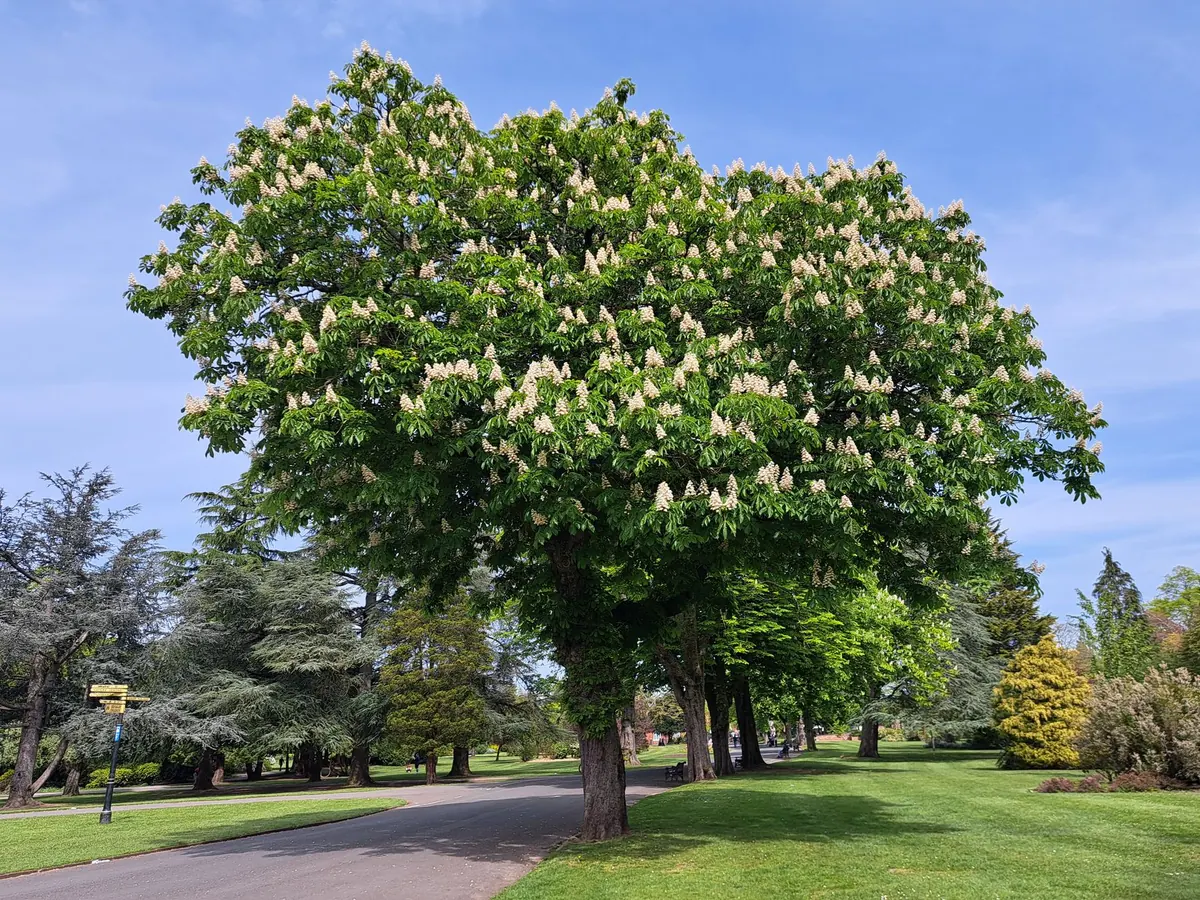
The horse chestnut, Aesculus hippocastanum, is the tree of school playgrounds, park avenues and village greens. It produces the seed everyone knows as a conker, holds up white flower spikes in May, and turns brown early, often before October is out. It arrived in Britain in the late 16th century from the mountains of the Balkans, planted purely for ornament — never for the table.
The sweet chestnut, Castanea sativa, is a Mediterranean tree grown here for centuries, valued for its nuts and for coppiced timber. It flowers in long creamy catkins in summer and keeps its leaves later. It belongs to the beech family, and some coppiced stools in southern England are centuries old.
The shared name comes from the resemblance between the two seeds, not from any family connection. One explanation of the "horse" prefix is that it once meant coarse, or fit only for animals. Either way, only one of the two is food.
It is worth adding that "chestnut" has been borrowed by at least one unrelated plant. The water chestnut of Chinese cooking is a sedge tuber, not a nut at all — and the chestnuts in a takeaway are almost always the same sweet chestnut, boiled and peeled.
Start With the Casing
When the husk is still wrapped around the seed — or lying broken under the tree — you have the quickest test available.
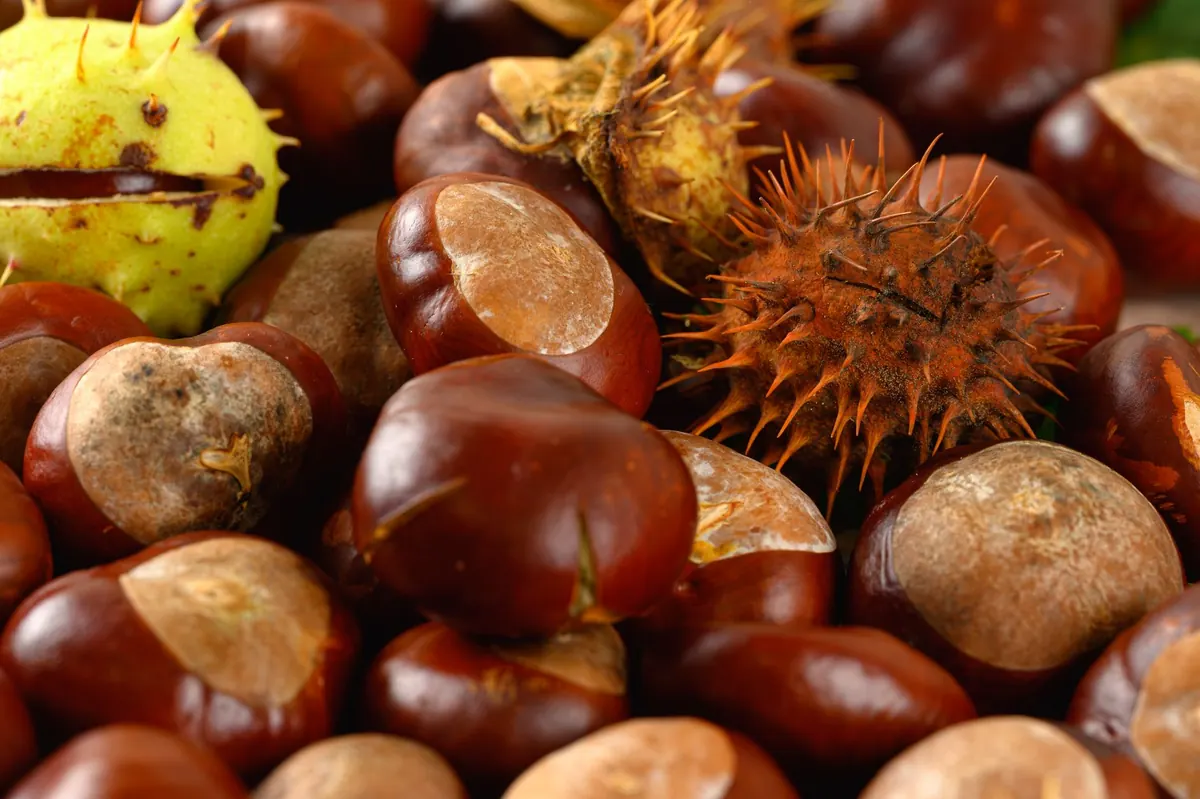
A horse chestnut husk is thick, leathery and green, studded with short, blunt, warty spikes. Run a thumb over it and it feels like a firm rubber ball with pimples. It usually holds one large conker, sometimes two or three, and splits into three valves as it dries. The common description is a golf ball with a bad case of acne, and it is not far off.
A sweet chestnut burr is a different object entirely: densely covered in long, thin, needle-sharp spines, so it looks and feels like a small sea urchin. Inside you will usually find two or three nuts, pressed together so that each has a flat side. That contrast — golf ball against sea urchin — is the single best memory hook in this whole article.
Both husks turn brown and split open as they ripen, and both are best left on the tree until they do. A green burr that has not begun to open means the nuts inside are not ready. Wear gloves, or use the toe of a boot, to pick them up. If picking one up bare-handed makes you yelp, you have found a sweet chestnut.
The Seed Itself
Once a seed is loose in your hand, look past the colour, which is unreliable — plenty of sweet chestnuts are the same deep brown as a conker.
A conker is round and glossy, with a pale, roughly circular scar where it sat against the inside of the husk. Roll it across a table and it keeps rolling. Drop it on a hard floor and it bounces. Cut one open and the inside is solid and uniform, with no kernel, no skin and no structure.
A sweet chestnut has a pointed tip, often with a small tuft of fluff, and at least one flattened side from being pressed against its neighbours in the burr. Its base scar is usually larger and more irregular — a paler patch rather than a neat circle. Cut one open and you find a proper kernel: a white, starchy nut wrapped in a thin brown skin, with a bitter membrane between the two.
Size is a poor guide. Conkers are usually bigger, but small conkers and large chestnuts both exist.
Look Up: Leaves, Buds and Bark
A seed on the ground is the end of the story; the tree above tells the same story more reliably.
Horse chestnut leaves are palmate: five to seven leaflets radiating from a single point like the fingers of a hand, each one toothed along the edge. A full leaf can be as wide as a dinner plate. In winter, look for large, shiny, sticky brown buds on twigs marked with horseshoe-shaped leaf scars — the giveaway that gave the tree its name.
Sweet chestnut leaves are simple rather than compound: one long, narrow blade of 15 centimetres or more, with sharply serrated edges and straight parallel veins running from the midrib out to each tooth. They are glossy dark green above and paler below.
Winter and bark clues
Old sweet chestnuts develop bark with deep, spiralling furrows. Horse chestnuts tend to have greyish bark that flakes away in plates. In winter you can still identify both from the buds, and from the husks lying underneath.
Why It Matters: Taste, Cooking and Safety
This is where the confusion stops being funny. Horse chestnuts — conkers — are not food. They contain aescin, a saponin, along with other compounds that cause stomach upset, and they taste bitterly unpleasant long before you could eat enough to do real harm. No amount of roasting turns a conker into a chestnut; the bitterness only concentrates.
Sweet chestnuts, by contrast, are a genuine food: starchy, faintly sweet, and the only nut in Europe that is mostly carbohydrate. Roast them after scoring the shell — the classic cross on the flat side — at around 200°C for twenty to thirty minutes, until the shell peels back and the kernel is soft. They also boil, steam, purée and dry well; in Italy and France, chestnut flour is still used for cakes and polenta.
Two kitchen warnings. Peel off both the shell and the thin inner skin, known as the pellicle: it is bitter and will spoil a dish. And do not eat them raw in quantity, as raw sweet chestnuts are hard to digest and mildly astringent. Cooked is the point.
Other Lookalikes Worth Knowing
The horse chestnut has relatives of its own. Buckeyes, such as Aesculus glabra, look very similar, and their seeds are just as inedible. In North America, "chestnut" once meant the American chestnut, Castanea dentata, now largely lost to blight; its nuts look like small sweet chestnuts and are genuinely edible. Chinkapins are its close, smaller cousins.
None of these are dangerous if you follow one rule: unless you have positively identified a spiny burr and a pointed nut with at least one flat side, do not eat it.
A Pocket Checklist
- Husk: short warty pimples = conker; long needle spines = sweet chestnut.
- Nuts per husk: usually one = conker; two or three = sweet chestnut.
- Shape: round and glossy = conker; pointed, with a flat side = sweet chestnut.
- Base scar: neat pale circle = conker; larger, irregular patch = sweet chestnut.
- Inside: solid and uniform = conker; white kernel in a brown skin = sweet chestnut.
- Leaves: five to seven leaflets from one point = conker; one long serrated blade = sweet chestnut.
- Buds: large, shiny and sticky = conker; small and scaly = sweet chestnut.
- Edible? Only the sweet chestnut. Conkers are not food at any stage.
If You Are Still Unsure
- Walk back to the tree and look up. The leaves settle it in seconds.
- Check the ground beneath for husks. The spiny ones are unambiguous.
- When in doubt, throw it back. A conker costs you nothing; a mistaken conker in a stew costs you dinner.
- Ask someone local. In Britain, October usually produces an adult within fifty metres who knows exactly which tree is which.
Do those checks in order and the bag on the kitchen table sorts itself out. The shiny round ones go in a tin for the playground, the pointed ones with a flat edge go in the oven — and nobody has to find out the hard way which was which.
Photo: Jana Ohajdova / Pexels